Shortly after midnight on Saturday, phones across several Brazilian states blared an official "extreme" emergency alert. The message was a single word: "misantropi4." That's the Portuguese word for misanthropy, hatred of humanity, with the final "a" swapped for a "4" in the keyboard-substitution style known as leetspeak.
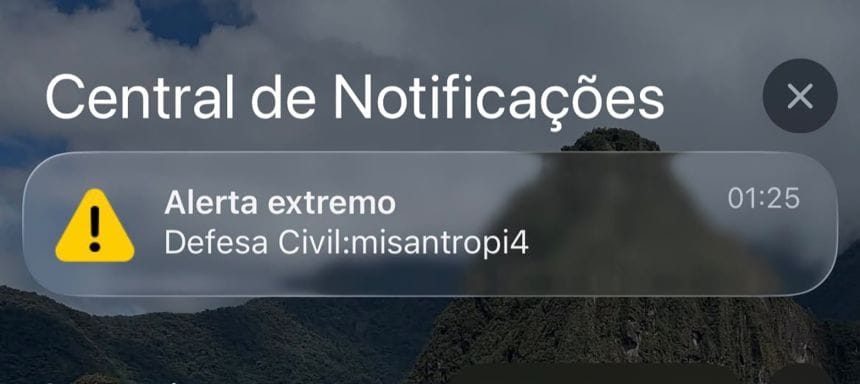
No flood, no fire, no missile. Just a government-grade klaxon, the kind reserved for life-threatening emergencies, announcing contempt for the human race to millions of sleeping people.
The alert first hit the southern state of Paraná, then a second one fired minutes later for São Paulo and Rio de Janeiro, two of the largest cities in the Americas. Some São Paulo residents reported getting the same text by ordinary SMS as well.
What's actually confirmed
Brazil's National Civil Defense says the message was triggered remotely by someone outside the national alert system and calls it "probably a hacker attack." São Paulo's Civil Defense confirmed none of its agents sent it and that there was no real emergency behind it. Rio's Civil Defense blamed "instability" in the federal IDAP/Cellbroadcast platform. The tool, managed by telecom regulator Anatel, was taken offline and remains down while authorities investigate.
So the core is real: an unauthorized extreme alert genuinely reached phones in major cities, and the official warning system is now switched off.
Here's where the viral version runs ahead of the evidence. The most-shared posts state flatly that "a hacker breached Brazil's national emergency alert system," with the Federal Police investigating. [1] The government's own wording is more cautious: it's a probable hacker attack, and Rio's agency floated system instability as an alternative. As of the official statements, "hacker" is the leading theory, not an established finding.
It also wouldn't be the first emergency-alert scare to get pinned on hackers prematurely, or to fire by mistake. A 2017 incident set off Dallas's entire tornado-siren network overnight, and Hawaii's infamous 2018 "ballistic missile inbound" warning turned out to be human error, not an attack. [2]
How is this even possible? Systems like this one work like the U.S. Wireless Emergency Alerts behind AMBER warnings: they broadcast to every device in a geographic area regardless of phone number or carrier, and they override silent mode. Whoever sent "misanthropy" had access to that lever.
On Hacker News, the reaction was less alarm than disappointment. "Of all the messages they could have sent they chose the most boring," one commenter wrote. [3]
What happens next: the platform stays offline until Anatel and federal investigators establish what, or who, triggered it.
Sources
Primary source: Unauthorized alert sent to cell phones across Brazil
- Tweet by @IntCyberDigest — @IntCyberDigest · community
- HN comment by Scoundreller — Scoundreller · community
- HN comment by mseepgood — mseepgood · community
- HN comment by throwaway81523 — throwaway81523 · community
- HN comment by p0w3n3d — p0w3n3d · community
- HN comment by jpablo — jpablo · community
- HN comment by knuppar — knuppar · community
- HN comment by initramfs — initramfs · community
- HN comment by WarOnPrivacy — WarOnPrivacy · community
- Tweet by @cnni — @cnni · community
- Tweet by @VECERTRadar — @VECERTRadar · community