For about five years, an octogenarian woman with advanced Alzheimer's disease had spoken mostly in single syllables. Roughly 19 hours after she swallowed five grams of psilocybin-containing mushrooms, she began speaking in spontaneous autobiographical sentences again.
That is the central claim of a case report published in Frontiers in Neuroscience on 28 May 2026, and it is currently spreading across social media as evidence that magic mushrooms can treat Alzheimer's. The documented event is genuinely startling. Almost everything surrounding it needs careful reading, and the authors are the first to say the obvious thing: this is one patient.
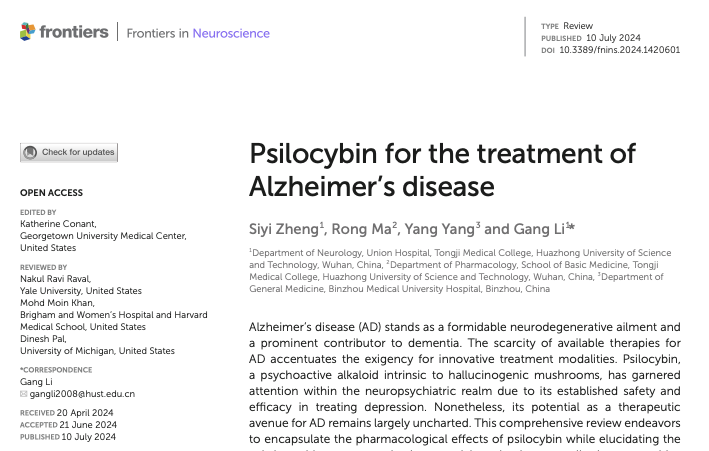
What the report describes
The patient is described as a Japanese-American woman in her eighties with a 10-year history of Alzheimer's, including five years of marked hypofunction. At baseline she had chronic urinary incontinence, difficulty swallowing, dependent mobility, a flat affect, and severely reduced spontaneous speech.
She was given 5 g of orally administered psilocybin mushrooms, identified as the "Enigma" strain. The acute phase was rough: autonomic activation, clinically suspected hyperthermia, heavy sweating, and a prolonged deep sleep-like state. About 19 hours after the dose, spontaneous autobiographical speech emerged.
Over the following days and weeks the report logs a long list of improvements: restored urinary continence, better walking, dressing herself, more emotional responsiveness, sustained social interaction, and contextual memory retrieval. A second supervised session using 3 g was given later, and one month after the first session the patient was reportedly still continent and functionally improved compared with her baseline. [1]
What the authors did not claim
Here is where the viral version and the actual paper part ways. The report's own conclusion states that the findings "do not imply disease reversal." The improvements were transient. The authors' careful framing is that residual functional capacity may persist in late-stage neurodegeneration and may become temporarily accessible under specific conditions.
So "psilocybin cures Alzheimer's" is simply not what the paper says. One Hacker News reader flagged this within minutes, quoting the conclusion and noting it was "not quite a 'successful treatment'." A separate account of the case, discussed by researcher Dean Radin on a recent Joe Rogan episode, described the effects as very short-lived. [2]
How psilocybin could even do this
The proposed mechanism is real pharmacology, not hand-waving. Psilocybin activates serotonin 5-HT2A receptors and produces large changes in brain-wide network activity, including altered default mode network integrity and reduced network segregation. Preclinical studies suggest serotonergic psychedelics can promote structural plasticity such as dendritic growth and synaptic remodeling.
The authors' hypothesis is that some functional circuitry survives even in advanced dementia and can be briefly unlocked by this kind of neuromodulation. It is a plausible story. A single case cannot prove it, because there is no control group, no blinding, and no way to rule out coincidence or another cause.
The red flags
This is the part the internet got right, and loudly. The study is n=1, the weakest tier of clinical evidence. The Alzheimer's diagnosis itself was never confirmed in the abstract; the condition was described as "considered clinically most compatible with advanced Alzheimer's disease," and the three authors list no university or hospital affiliation, only a medical department at an organization called Associação Cruz de Ankh in São Paulo. [3]
“> n=1 > pay to publish journal > no clear Alzheimers diagnosis ("[...] were considered clinically most compatible with advanced Alzheimer’s disease") > administration of a heroic dose of street-quality drugs vs. a controlled sample > no university or hospital affiliation? Extraordinary claims require extraordinary evidence, hence I remain skeptical”
Then there is the dose. Five grams of dried mushrooms is what the psychedelic community calls a heroic dose, and giving it to a frail patient in her eighties raised eyebrows even among readers sympathetic to the research. [4]
“Good riddance - this kind of thing needs to be experimented with more. But 5 grams! This reads like witch doctor science; I’m surprised it passed ethics”
The venue draws scrutiny too. Frontiers has been described by some researchers as a predatory or borderline publisher, and the same publishing group became briefly famous for a retracted paper containing an AI-generated diagram of a rat with anatomically impossible features. [5] None of this proves the case is fabricated. It does mean the gatekeeping you would assume sits behind a "breakthrough" headline may be thinner than it looks.
What people are saying
The Hacker News thread is overwhelmingly skeptical rather than excited, which is itself notable for a story this sensational. One widely shared comment summarized the mood bluntly, calling the report "full of red flags from top to bottom" and describing it as "an 80 year old Japanese woman received mushrooms and was better afterward" dressed up in as much medical jargon as possible. [6]
“This case report is being shared widely across social media but it’s full of red flags from top to bottom. It’s a case report (n=1) that a group of 3 people from Brazil wrote up and pushed into the publishing world. The report is full of big words and tables, but barely says anything more than the abstract: It’s basically “an 80 year old Japanese women received mushrooms and was better afterward” expanded with as much medical jargon as they could apply without accidentally getting too specific. No mention of how the Alzheimer’s disease history was documented or diagnosed or even if she was a p”
Not everyone dismissed it. Several commenters argued the underlying idea deserves serious study even while wincing at the execution.
What would confirm it
The honest answer is that nothing here is settled. What would move this from anecdote toward evidence is a diagnosis documented with biomarkers or imaging, and a controlled trial with more than one patient. Radin also mentioned a company developing a drug that targets the same receptors as psilocybin without the psychedelic effects, delivered nasally, with the hope of a longer-lasting benefit. Until something like that is tested and independently replicated, the most accurate description of this story is the one the authors themselves wrote: a single, transient, unexplained improvement in one person. Remarkable if real, and still just one.
Sources
Primary source: Successful Psilocybin Treatment of Alzheimer
- HN comment by trio8453 — trio8453 · community
- HN comment by 40four — 40four · community
- HN comment by sva_ — sva_ · community
- HN comment by UnfitFootprint — UnfitFootprint · community
- HN comment by jszymborski — jszymborski · community
- HN comment by Aurornis — Aurornis · community
- HN comment by trumpdong — trumpdong · community
- HN comment by ChrisArchitect — ChrisArchitect · community