Divers found the body of Yemen's "Spider-Man" 30 metres below the surface of a sulfurous lake, at the bottom of a volcanic crater he had been climbing without a rope, a harness, or any other safety equipment. [1]
That is the part that sounds invented, and it is the part that is confirmed. Al-Qaqa Ibn Antar, a 30-year-old social media free-climber, fell while scaling the near-vertical inner wall of the Hardah Dam crater in southern Yemen on Friday, June 12, 2026. Yemen's Civil Defense Authority, which ran the recovery, released a short video that appears to capture the moment his grip fails and he drops out of frame. The footage has circulated widely since.
Who he was
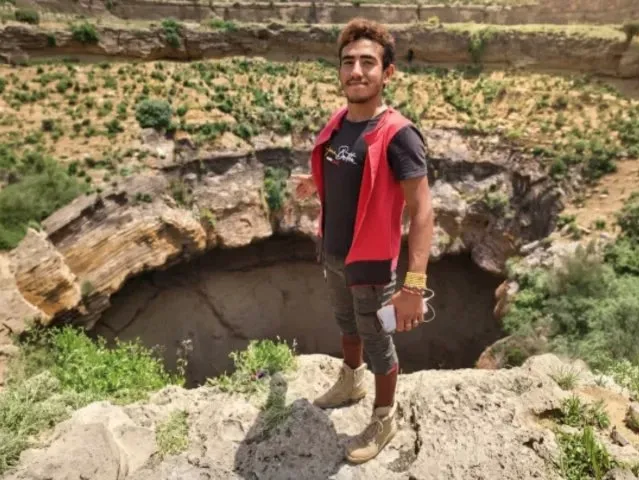
Antar built his following the way the nickname suggests: by filming himself clinging to cliffs and rock faces across Yemen with little or no protective gear, dangling from ledges by his bare hands, turning some of the country's most rugged terrain into a stage. He had amassed more than 320,000 followers on Facebook, and some of his reels reached millions of views. [2]
The "Spider-Man of Yemen" label was not a posthumous invention by headline writers. It was how he was known online while he was alive and climbing, which is part of why the news spread so fast.
The crater
The place he died is a genuine landmark, not an obscure pit. The Hardah Dam crater, also written as Haradhat Damt, sits near the town of Damt in Dhale province and has become something of a tourist draw, largely because of the hot mineral lake at its base. The same features that make it photogenic are what make it lethal: steep, jagged, unstable volcanic rock above water fed by sulfur springs. [3]
Here is where the viral version of the story needs a correction. You will see the crater described over and over as "120 metres (393 feet)," and many readers have taken that as how far Antar fell. It isn't. The BBC's reporting specifies the figure is the crater's width, not a vertical drop. The depth that matters for the recovery is a separate number: his body was located 30 metres, roughly 100 feet, beneath the surface of the lake.
So the mechanism of the absurd-sounding outcome is straightforward once the numbers are sorted. He fell from the rock wall into the water, then sank well below it, in a basin ringed by sharp terrain with almost no easy access. A fall into a lake is survivable in the abstract. A fall into this lake, in this crater, was not.
The recovery
Getting him out took longer than the fall and was, by the rescuers' own account, brutal. The Civil Defense Authority dispatched diving and water rescue teams the same day. Divers located the body on Friday, but the actual retrieval was not completed until the next day, June 13. [2]
The agency described it as "one of the most difficult and complex field rescue missions," citing the rugged terrain, the depth, and the high temperatures inside the crater. The Media Line reported the recovery effort ran about four hours. [3] Footage released by the authority shows rescuers scaling down the crater wall on climbing equipment and winching a cage to the bottom to bring the body up. Yemen's official news agency, Saba, carried the same account of the conditions, and the AP, USA Today, the BBC and The Media Line have all reported the core facts consistently.
The rescuers were promoted and honored at a ceremony on June 14, according to the authority's posts.
What's solid and what's fuzzy
The spine of this story is well sourced. Multiple international outlets carried it independently, all tracing back to the Civil Defense Authority's statements and video plus on-the-ground reporting, including from the Associated Press.
The soft spots are in the details, not the event. His name appears in at least three forms: the BBC, AP and The Media Line use "Al-Qaqa Ibn Antar," while USA Today renders his full name as "Al-Qaqa' Antar Al-Absi," and the Civil Defense Authority's own translated post calls him "Qa'qa' Antar al-Abssi." [2] That kind of variation is normal in transliteration from Arabic and does not signal any doubt about who died. The follower count comes from a single outlet's reporting rather than a verified platform tally, so treat 320,000 as the best available figure rather than an audited one. And the precise depth in feet wobbles between sources, listed as 98 feet by the BBC and 100 feet by the AP and others, which is just rounding of the same 30-metre measurement.
What the sources do not establish is anything about the stunt's intent or whether the video being shared is the complete sequence. The authority released a "short video." How much it shows, and what led directly to the slip, is not something the reporting pins down.
What we still don't know
No outlet in the available reporting gives a cause beyond the obvious "lost his grip," and none cites a formal investigation. There is no confirmed detail on whether anyone was filming alongside him, whether the climb was a planned shoot, or what condition the body was recovered in. Those are the gaps to watch if Yemeni authorities or family release more.
For now the confirmed story is the remarkable one. A man known across Yemen for climbing without ropes climbed one more wall without ropes, fell into a hot sulfur lake inside a famous volcanic crater, and was pulled from 30 metres of water in a recovery the rescuers themselves called one of their hardest.
Sources
Primary source: 'Spider-Man of Yemen' dies falling into volcanic crater
- ‘Spider-Man of Yemen’ dies in fall while climbing volcanic crater - AP News — reporting
- 'Spider-Man of Yemen' dies after falling into volcanic crater - USA Today — reporting
- Yemen’s ‘Spider-Man’ Dies in Volcanic Crater Fall - The Media Line — reporting
- ‘Spider-Man of Yemen’ dies after falling into a volcano crater during climb - The Lufkin Daily News — reporting