A wealthy democracy of nine million people just voted on whether to write a hard ceiling into law: no more than ten million residents, ever, with the machinery of immigration policy bent toward keeping the count below it. On Sunday, Switzerland said no. Early projections put the result at about 55% against to 45% in favor. [1]
That is the part worth sitting with. This was not a poll or a petition gathering dust in a parliamentary committee. It was a binding national referendum, and had it passed, the Swiss government would have been legally obligated to start managing the population down toward a number. [2] The country chose not to. But it was closer than the word "rejected" suggests.
The numbers on the ballot
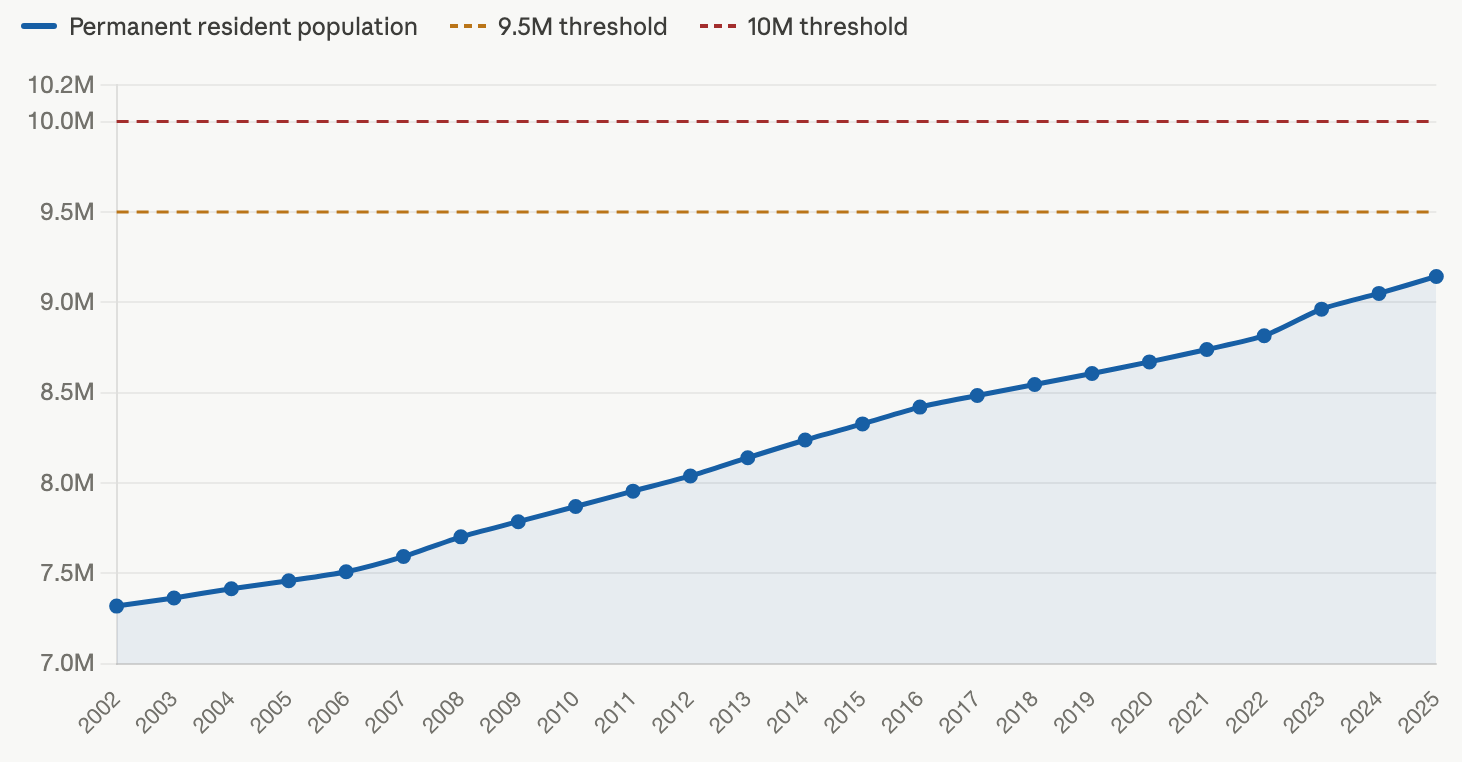
Switzerland's population stood at just over 9.1 million at the end of 2025, after growing 10% over the previous decade. [2] For the first time, the country had more people over 65 than under 20. Net migration and the birth rate both fell last year, which makes the timing of a runaway-growth vote a little awkward.
The longer arc is steeper. The population was 7.3 million in 2002 and is 9.1 million now, with 27% of residents not holding Swiss citizenship. [1] An estimated 1.4 million EU citizens live in the country, and another 340,000 cross the border every day just to go to work.
The proposal came from the right-wing Swiss People's Party, the SVP, which has campaigned on restricting immigration for years. It reached the ballot the way everything reaches the ballot in Switzerland: under the country's system of direct democracy, gathering 100,000 signatures is enough to force a nationwide vote.
How the cap would have actually worked
This is the mechanism that turns a slogan into law, and it is more specific than the headline number implies.
If voters had approved it, the Federal Council and parliament would have had to roll out measures to curb population growth, with a deadline of 2050. The first trigger sat below the headline figure. Should the population pass 9.5 million at any point over the next 24 years, immigration systems would tighten, and asylum and family reunification programs were named as the first in line to be cut.
The ten-million line was the hard one. If the population rose above it, Switzerland's freedom-of-movement agreement with the European Union would potentially have to end. That is the detonator nobody in business circles wanted to touch. Switzerland is not in the EU, but it is inside the border-free Schengen zone and has a bilateral deal letting EU and Swiss citizens live and work in each other's territory. Over half of all Swiss products are sold into the EU, and that market access is tied to Switzerland honoring free movement of people. Approving the cap would have meant terminating the agreement that underwrites the export economy.
So the vote was never only about a number. It was a vote on whether to keep the deal that lets Nestlé, Novartis and a long list of multinationals operate from a country of nine million while selling into a market of hundreds of millions. Economiesuisse, the business association, warned that passage would create "challenges in our relations with the European Union," in the words of its chief economist Rudolf Minsch.
Worth correcting one thing the loudest version of this story gets wrong: a "yes" would not have shut the borders. The SVP itself said the cap would still allow 40,000 people to move to Switzerland each year. The party framed it as a brake, not a wall, arguing through lawmaker Piero Marchesi that growth had strained public services, wages, rent, education and the labor market.
What the two sides said
The campaign had a face on each side, and the BBC spoke to both before the vote. Nils Fiechter, a 29-year-old SVP member of canton Bern's parliament, put it bluntly: "We have lost control," he said, arguing that "unchecked immigration is leading to Switzerland no longer being Switzerland." Fiechter and a co-president of the party's youth wing were convicted of racial discrimination by the Swiss Federal Court in 2022, over a poster they distributed in 2018.
On the other side, Helin Genis, a 31-year-old Social Democrat on Bern's city council, rejected the premise. "It is not migrants who determine rent levels. It is not migrants who raise health insurance premiums," she told the BBC, calling the housing-and-services argument a way of viewing problems "through the lens of migration."
What people are saying
On Hacker News, where an earlier thread about the upcoming vote had hit the front page, the result drew a mix of relief and wariness. One commenter who flagged the outcome did so almost as a footnote to that earlier discussion. [3]
The more pointed reactions focused on how close 55-45 really is. "This is still very close for comfort," one user wrote, predicting the SVP "will re-propose it again and again and again as it and its predecessors have done for decades." [4]
“> Swiss citizens have rejected by a 55% majority... This is still very close for comfort, and SVP will re-propose it again and again and again as it and it's predecessors have done for decades.”
Another reading credited the result to the urban-rural split that decides so many of these votes:
“Cities once again save rural voters from civic suicide.”
A longer comment situated the whole episode in a continental trend, calling it the political equivalent of overtourism and a problem for ruling parties everywhere, not only in Switzerland. The same commenter offered a cultural read on the Swiss instinct here: "Welcome guests but expect them to leave again." [5] Treat that as one person's framing rather than data, but it captures the ambivalence a 45% "yes" vote leaves behind.
Where this goes from here
The headline result is firm: the projections show a clear rejection, and the free-movement agreement with the EU survives intact for now. What is not settled is whether the question stays answered. Switzerland's direct democracy means another 100,000 signatures can put a version of this back on the ballot, and the closeness of the margin is exactly the kind of result that invites a sequel. [4]
Two things are worth watching. The first is the final certified count, since these figures come from early projections before all votes were tallied. The second is whether the underlying pressures the campaign named, housing, rent and aging, ease on their own now that net migration and the birth rate have already turned down. If they don't, the ten-million number is not going away. It just lost a vote.
Sources
Primary source: Swiss voters reject proposal to cap population at ten million
- Swiss voters reject 10 million population cap, early projections say — reporting
- Switzerland to vote on plan to cap population at 10 million — reporting
- HN comment by FabCH — FabCH · community
- HN comment by alephnerd — alephnerd · community
- HN comment by abc03 — abc03 · community
- HN comment by jeffbee — jeffbee · community