Biologists packed nonliving molecules into a membrane, one piece at a time, and watched the bag of chemicals start acting like life: it grew, copied its DNA, and divided into daughter cells. That is the whole basic cell cycle, assembled from a parts list instead of inherited from a living ancestor.
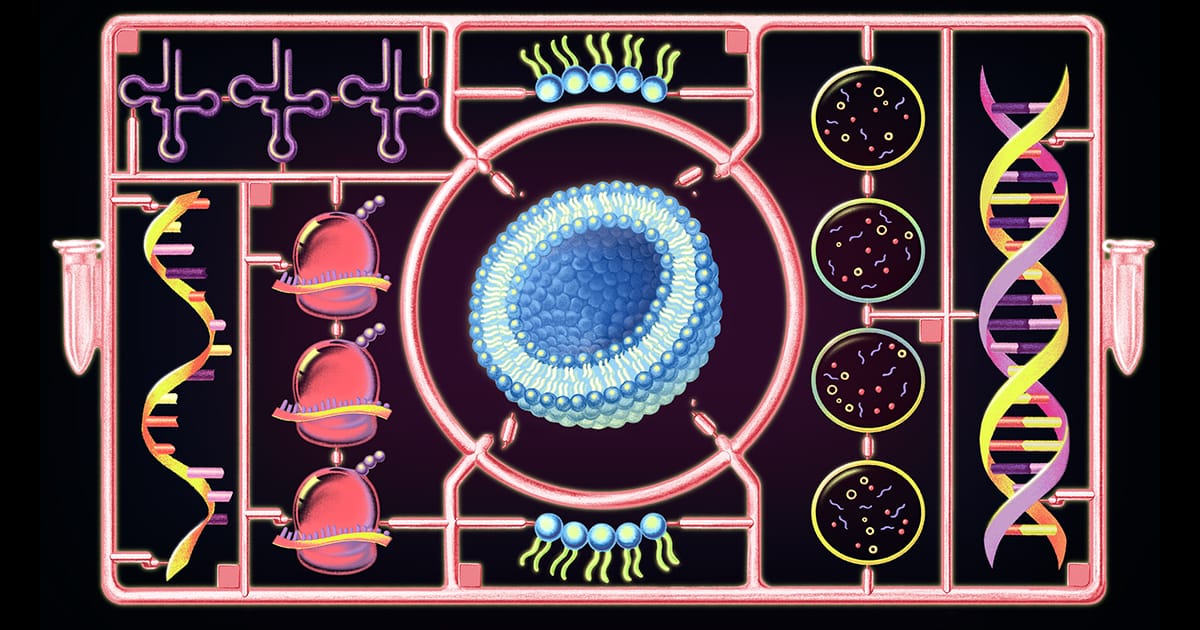
The work was led by Kate Adamala, a synthetic biologist at the University of Minnesota. "I have a blueprint, I have a full chemical ingredient list of every component," she said. Jack Szostak, an origins-of-life researcher who wasn't involved, called it "an impressive step" and said he knew of no other artificial-cell effort that had gotten so far.
Now the part the viral version skips: it is not alive, by any definition, the researchers say. The cell can't survive without constant deliveries of food and of ribosomes, the machinery that makes proteins. It has no defenses and no real waste removal. One tweet with more than 2,000 likes said the cell can "feed, grow, and replicate—just like a natural cell" [1], which is true for the verbs and misleading on the "just like." The paper also isn't peer-reviewed yet.
How a bag of molecules divides
Cells normally split by reorganizing their cytoskeleton, the internal protein scaffolding, and nobody could get a synthetic cell to pull off that maneuver. It was where the field had been stuck for years. So Adamala skipped the cytoskeleton entirely, finding a different division mechanism buried in the literature and building around it. [2]
That shortcut is exactly what has other scientists talking. "Can someone in this field comment on the implications of sidestepping the cytoskeleton?" asked one top comment on Hacker News. [3] Others went straight to unease about where the whole project leads.
“> “It’s a big step forward to this holy grail of making a living thing out of dead components,” said Sijbren Otto, a systems chemist at the Stratingh Institute for Chemistry in the Netherlands who was not involved in the work. That is the holy grail? I get that the goal is to "grow" biofuels, plastic, fertilizer, drugs, or whatever else we can imagine. But is that worth the many apocalyptic sci-fi outcomes we can imagine?”
The upside Adamala points to: because every part is swappable, this kind of cell could eventually be tuned to make biofuels, drugs, or new materials, and to help study disease. It is the same Adamala who a couple of years ago helped call for a halt to mirror-life research over safety concerns. [4]
What's confirmed: a made-from-scratch cell ran a full cell cycle in a lab. What isn't: that it's alive, or that the result survives peer review.
Sources
Primary source: For the First Time, a Cell Built From Scratch Grows and Divides | Quanta Magazine
- Tweet by @TheInsiderPaper — @TheInsiderPaper · community
- HN comment by JumpCrisscross — JumpCrisscross · community
- HN comment by soraki_soladead — soraki_soladead · community
- HN comment by burnte — burnte · community
- HN comment by bensyverson — bensyverson · community
- HN comment by small_model — small_model · community
- HN comment by mghackerlady — mghackerlady · community
- HN comment by HanClinto — HanClinto · community
- HN comment by codemax98 — codemax98 · community
- Tweet by @ysuckme — @ysuckme · community
- Tweet by @nerdseungmin — @nerdseungmin · community